A More Advanced Approach to Pain, Performance, Stress & Nervous System Health
What if acupuncture could do more than simply address the place where you hurt?
What if treatment could also target the nervous system that controls pain, movement, muscle function, stress response, sleep, focus and recovery?
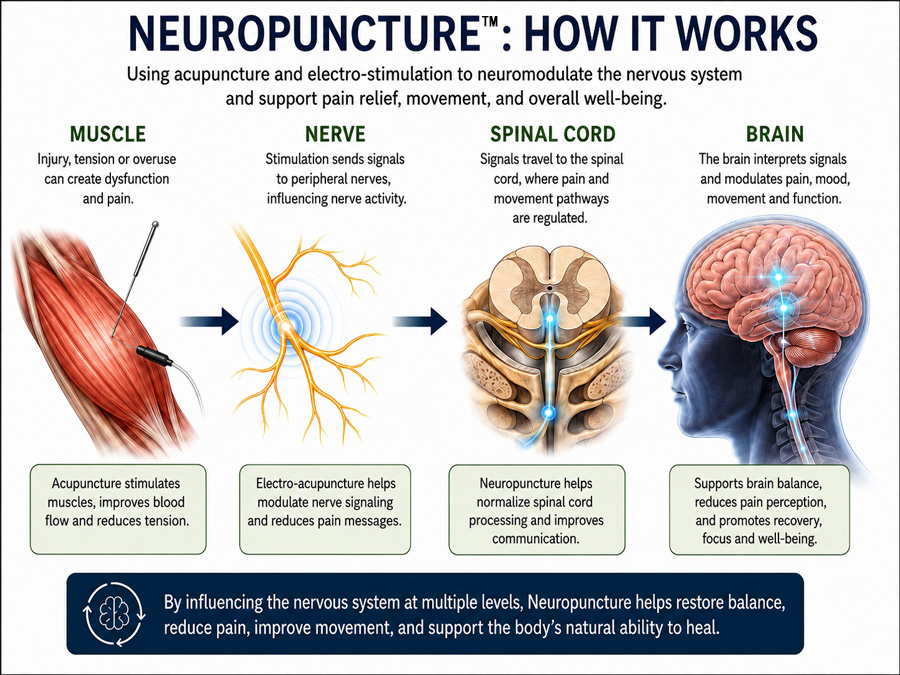
Welcome to Neuropuncture—a modern, neuroscience-based system of electro-acupuncture that bridges thousands of years of acupuncture knowledge with our rapidly evolving understanding of the brain and nervous system.
At AcuSportsTherapy in Delray Beach, Neuropuncture is incorporated into an integrated approach to help patients dealing with pain, sports injuries, neurological dysfunction, chronic stress and other conditions involving nervous-system regulation.
For athletes, active adults and people simply trying to feel and function better, this creates an important shift in treatment:
We aren’t only asking, “Where does it hurt?”
We are also asking:
“What is happening within the nervous system that may be contributing to the problem—and how can we influence it?”
What Is Neuropuncture?
Neuropuncture is a specialized acupuncture system developed by Dr. Michael Corradino that combines acupuncture with modern neuroscience, neuroanatomy, neurophysiology and electro-acupuncture.
Rather than viewing acupuncture exclusively through the traditional energetic model, Neuropuncture examines how carefully selected acupuncture points and electrical stimulation may influence specific neurological pathways and physiological responses.
The goal is to use acupuncture strategically to help:
- Neuromodulate nervous-system activity
- Support healthier neurological signaling
- Influence pain-processing pathways
- Support autonomic nervous-system regulation
- Improve neuromuscular communication
- Encourage neurological rehabilitation
- Support the brain-body connection
In simple terms, Neuropuncture uses acupuncture as a way of communicating with the nervous system.
And because your nervous system influences nearly everything you do—from moving your shoulder to processing pain to managing stress—that opens the door to a much broader way of thinking about treatment.
Why the Nervous System Matters
Your nervous system is your body’s communication network.
Every movement, sensation, reflex and physiological response involves communication between your brain, spinal cord, peripheral nerves and the rest of your body.
It helps determine:
- How strongly you perceive pain
- How muscles activate
- How efficiently you move
- How quickly you react
- How well you coordinate movement
- How you respond to physical and emotional stress
- How easily your body transitions between “fight or flight” and “rest and recovery”
- How well you sleep
- How clearly you focus
- How effectively you recover
When this system becomes irritated, overloaded or poorly regulated, the problem may extend well beyond one painful muscle or joint.
That is one reason two people can have nearly identical imaging results but experience completely different levels of pain and disability.
Pain is not simply a tissue problem. It is also a nervous-system experience.
Neuropuncture gives us another tool for addressing that larger neurological picture.
Neuropuncture + Sports Medicine Acupuncture
This is where Neuropuncture becomes especially exciting at AcuSportsTherapy.
Sports injuries rarely exist in isolation.
A painful knee, shoulder, Achilles tendon or lower back may involve damaged or irritated tissue—but it can also involve altered muscle recruitment, protective guarding, nerve irritation, movement compensation and changes in how the nervous system is controlling the area.
That is why treating only the location of pain may not always be enough.
At AcuSportsTherapy, Neuropuncture can be combined with sports medicine acupuncture, orthopedic assessment, trigger-point treatment, electro-acupuncture, neuromuscular techniques and movement evaluation to look at both sides of the equation:
The Tissue
Muscles, tendons, fascia, joints and surrounding structures.
The Nervous System
The neurological signals influencing pain, movement, muscle recruitment, coordination and recovery.
The goal isn’t merely to quiet an angry shoulder or knee.
The goal is to help the entire system function better.
Supporting Injury Recovery
After an injury, your nervous system naturally attempts to protect you.
Initially, that’s helpful.
Pain limits movement. Muscles tighten. Movement patterns change.
But sometimes those protective patterns continue long after they are useful.
The body may begin compensating.
One group of muscles works too hard while another stops activating efficiently. Movement becomes guarded. Pain becomes easier to trigger.
This can be one reason an injury feels as though it “just won’t completely go away.”
By incorporating Neuropuncture into sports injury treatment, we can address not only the local tissues but also the neurological component of recovery.
Depending upon the individual, treatment may be used as part of a comprehensive plan for conditions such as:
- Neck and back pain
- Shoulder injuries
- Rotator cuff problems
- Tennis and golfer’s elbow
- Hip pain
- Knee pain
- Achilles tendinopathy
- Plantar fasciitis
- Sciatic-type pain
- Muscle strains
- Overuse injuries
- Chronic sports injuries
- Nerve-related pain
- Persistent pain after an injury has healed
- Muscle inhibition or poor activation following injury
Neuropuncture for Athletic Performance
You don’t necessarily have to be injured to benefit from looking at the nervous system.
Athletic performance is neurological.
Your brain and nervous system determine how quickly and efficiently muscles are recruited.
Speed, coordination, balance, precision, reaction time and movement efficiency all depend heavily on neurological communication.
The nervous system is essentially the athlete’s operating system.
You can strengthen the hardware—but if the operating system isn’t functioning efficiently, performance may still suffer.
For athletes and active adults, Neuropuncture may therefore be incorporated into treatment programs designed to support:
- Neuromuscular coordination
- Efficient muscle recruitment
- Movement quality
- Recovery between workouts or competitions
- Pain management
- Mental focus
- Stress regulation
- Sleep and recovery
- Overall nervous-system resilience
This can be particularly valuable for runners, cyclists, golfers, tennis players, pickleball players, equestrians, strength athletes and other active adults who repeatedly ask their nervous system to perform at a high level.
Your Brain Is Part of Your Sports Medicine Treatment Too
Peak performance is not purely physical.
Any athlete who has competed seriously knows this.
You can be physically prepared and still perform poorly when the nervous system is overloaded.
Stress can change:
- Muscle tension
- Breathing patterns
- Reaction time
- Sleep quality
- Recovery
- Pain sensitivity
- Concentration
- Decision-making
That is why the mental and physical sides of performance should not always be separated.
At AcuSportsTherapy, our approach recognizes that your brain, nervous system and musculoskeletal system are constantly communicating.
Sometimes improving performance means treating a painful tendon.
Sometimes it means restoring better muscle activation.
And sometimes it means helping an overworked nervous system finally come out of overdrive.
Neuropuncture for Stress, Anxiety & Mental Well-Being
Neuropuncture is not limited to orthopedic or neurological conditions.
The Neuropuncture system also includes a dedicated mental-health component because emotional health and neurological regulation are deeply connected.
Your autonomic nervous system constantly moves between two broad physiological states.
Sympathetic Activity
Often referred to as “fight or flight.”
This system prepares you to respond to stress.
Parasympathetic Activity
Often associated with “rest, digest and recovery.”
Both are necessary.
Problems can arise when the body has difficulty moving out of a prolonged high-alert state.
Modern life makes this incredibly common.
Work stress.
Family responsibilities.
Constant stimulation.
Intense training.
Poor sleep.
Chronic pain.
And for competitive athletes, the psychological pressure to perform.
All of these can influence nervous-system regulation.
Neuropuncture and acupuncture may be incorporated as supportive care for people experiencing:
- Stress
- Anxiety
- Mental fatigue
- Difficulty relaxing
- Sleep disturbances
- Emotional tension
- Brain fog
- Difficulty focusing
- Stress-related muscle tension
- Feeling chronically “wired”
- Stress associated with chronic pain
Treatment is not intended to replace appropriate psychological or psychiatric care when that care is needed.
Instead, it can serve as another component of a whole-person approach to nervous-system health.
The Pain-Stress Connection
One of the most overlooked relationships in healthcare is the interaction between pain and stress.
Pain creates stress.
Stress can amplify pain.
Then poor sleep makes both worse.
The patient can become caught in a frustrating neurological loop:
Pain → stress → muscle tension → poor sleep → increased pain sensitivity → more pain.
This is particularly common in chronic injuries.
Someone may initially injure a shoulder, back or knee—but months later, the nervous system itself may become increasingly protective and sensitive.
This doesn’t mean the pain is imaginary.
Quite the opposite.
It means pain is complex.
A successful strategy sometimes needs to address the injured tissue and the neurological environment surrounding it.
This is one of the areas where Neuropuncture fits particularly well within the AcuSportsTherapy philosophy.
Electro-Acupuncture: A Precise Neurological Signal
Neuropuncture commonly incorporates carefully selected electrical stimulation through acupuncture needles.
The stimulation is controlled and tailored to the treatment objective.
Patients often describe it as a mild tapping, pulsing or rhythmic sensation.
Different frequencies and treatment strategies may be chosen depending upon the neurological pathways and physiological responses the practitioner is attempting to influence.
Instead of simply placing needles around a painful area, the treatment is designed around a specific neurological purpose.
Think of it as giving the nervous system a carefully selected input and encouraging it toward a healthier response.
Beyond “Traditional” Acupuncture
Traditional Chinese Medicine remains an extraordinary medical system with thousands of years of clinical history.
Neuropuncture doesn’t require abandoning that foundation.
Instead, it gives us another lens.
Traditional acupuncture may describe a treatment according to meridians, Qi and classical patterns.
Neuroscience may examine that same treatment through:
- Peripheral nerve stimulation
- Spinal cord pathways
- Brain signaling
- Neurochemical activity
- Autonomic regulation
- Motor control
- Pain modulation
These aren’t necessarily competing explanations.
They are different languages for understanding the extraordinarily complex human body.
At AcuSportsTherapy, this integration fits naturally with our philosophy:
Respect what traditional medicine has taught us while incorporating what modern science continues to reveal.
Neuropuncture + Sports Acupuncture + Functional Medicine
Your nervous system does not exist in a vacuum.
Its function can also be influenced by factors such as:
- Sleep
- Blood-sugar regulation
- Nutrient status
- Hormonal balance
- Inflammation
- Gut health
- Physical conditioning
- Recovery
- Emotional stress
This is where the broader AcuSportsTherapy approach becomes particularly valuable.
For some patients, acupuncture and Neuropuncture may be the primary focus.
For others, we may also look at functional medicine, nutrition, lifestyle, recovery strategies and other factors affecting the body’s ability to heal and regulate itself.
The ultimate goal is not simply to chase symptoms.
It is to ask a better question:
What is preventing your body from functioning at its highest level?
Who May Benefit From Neuropuncture?
Neuropuncture may be worth exploring if you are:
- An athlete dealing with a recurring injury
- An active adult who wants to keep moving as you age
- Experiencing chronic or persistent pain
- Dealing with nerve-related discomfort
- Recovering from a musculoskeletal injury
- Struggling with muscle tightness or guarding that keeps returning
- Looking for additional support for stress or anxiety
- Having difficulty relaxing or sleeping
- Experiencing high physical or mental stress
- Interested in improving recovery and athletic performance
- Seeking an integrative approach that combines acupuncture with modern neuroscience
You do not have to be an athlete.
Many of our patients simply want to move better, hurt less, think more clearly, manage stress more effectively and continue doing the things they love.
What Does a Neuropuncture Treatment Look Like?
No two treatments should be identical because no two nervous systems are identical.
Your visit begins with an evaluation of your symptoms, history and goals.
If your primary concern is musculoskeletal, your assessment may also include orthopedic testing, posture, movement, muscle function and evaluation of the affected region.
Your treatment may incorporate a combination of:
- Neuropuncture
- Electro-acupuncture
- Sports medicine acupuncture
- Traditional acupuncture
- Trigger-point techniques
- Neuromuscular treatment
- Cupping
- Manual therapy
- Therapeutic or corrective exercise
- Functional medicine strategies when appropriate
Treatment is individualized according to what your body needs—not according to a one-size-fits-all protocol.
Why AcuSportsTherapy?
At AcuSportsTherapy, we don’t believe you should be reduced to a diagnosis.
A painful knee belongs to a person.
A shoulder injury belongs to a nervous system.
Stress affects muscles.
Sleep affects recovery.
Nutrition affects healing.
And the way you move affects virtually everything.
That is why our approach combines sports medicine acupuncture, modern neuroscience (Neuropuncture ™), orthopedic evaluation and functional medicine principles to look beyond the symptom and toward the larger picture.
Whether your goal is returning to competition, getting back onto the golf course, walking without pain, sleeping better or simply feeling like yourself again, treatment is designed around one central goal:
Helping Your Body and Nervous System Perform at Their Highest Potential
You don’t need to be a professional athlete.
You simply need to be serious about your health.
Discover Neuropuncture in Delray Beach
If you’ve been treating the same painful area repeatedly without addressing the larger neurological picture, it may be time for a different approach.
Neuropuncture gives us the opportunity to work with the nervous system rather than focusing only on where symptoms appear.
At AcuSportsTherapy, we integrate the science of the nervous system with the art of acupuncture, sports medicine and whole-person care.
Because healing isn’t only about turning pain off.
It’s about helping your body move better, regulate better, recover better and perform better.
Ready to Find Out If Neuropuncture™ Is Right for You?
Schedule an appointment with AcuSportsTherapy in Delray Beach, Florida and discover a neuroscience-based approach to pain relief, injury recovery, stress regulation and optimal performance.
Book Your Neuropuncture Consultation Today.
